Buying your first car is a milestone. Whether it’s a brand-new SUV, a reliable used hatchback, or your dream sports sedan, owning a vehicle brings freedom and convenience. But before you hit the road, there’s one thing you simply can’t afford to ignore—car insurance.
If you’ve ever searched for car insurance online, you’ve probably come across terms like liability coverage, deductibles, premiums, comprehensive insurance, and collision coverage. For someone buying insurance for the first time, it can feel like learning a completely new language.
The truth is, car insurance doesn’t have to be confusing.
Once you understand the basics, choosing the right policy becomes much easier. More importantly, you’ll avoid paying for coverage you don’t need—or worse, ending up underinsured when you need protection the most.
Whether you’re a new driver in the United States, purchasing your first policy in the United Kingdom, or buying motor insurance in India, the fundamental purpose remains the same: protecting yourself financially from unexpected events.
In this comprehensive beginner’s guide, you’ll learn:
- What car insurance actually is
- Why every driver needs it
- The different types of coverage explained in simple language
- How insurance premiums are calculated
- Ways to lower your insurance costs
- Common mistakes first-time buyers make
- How to choose the right insurance policy with confidence
Let’s start with the most important question.
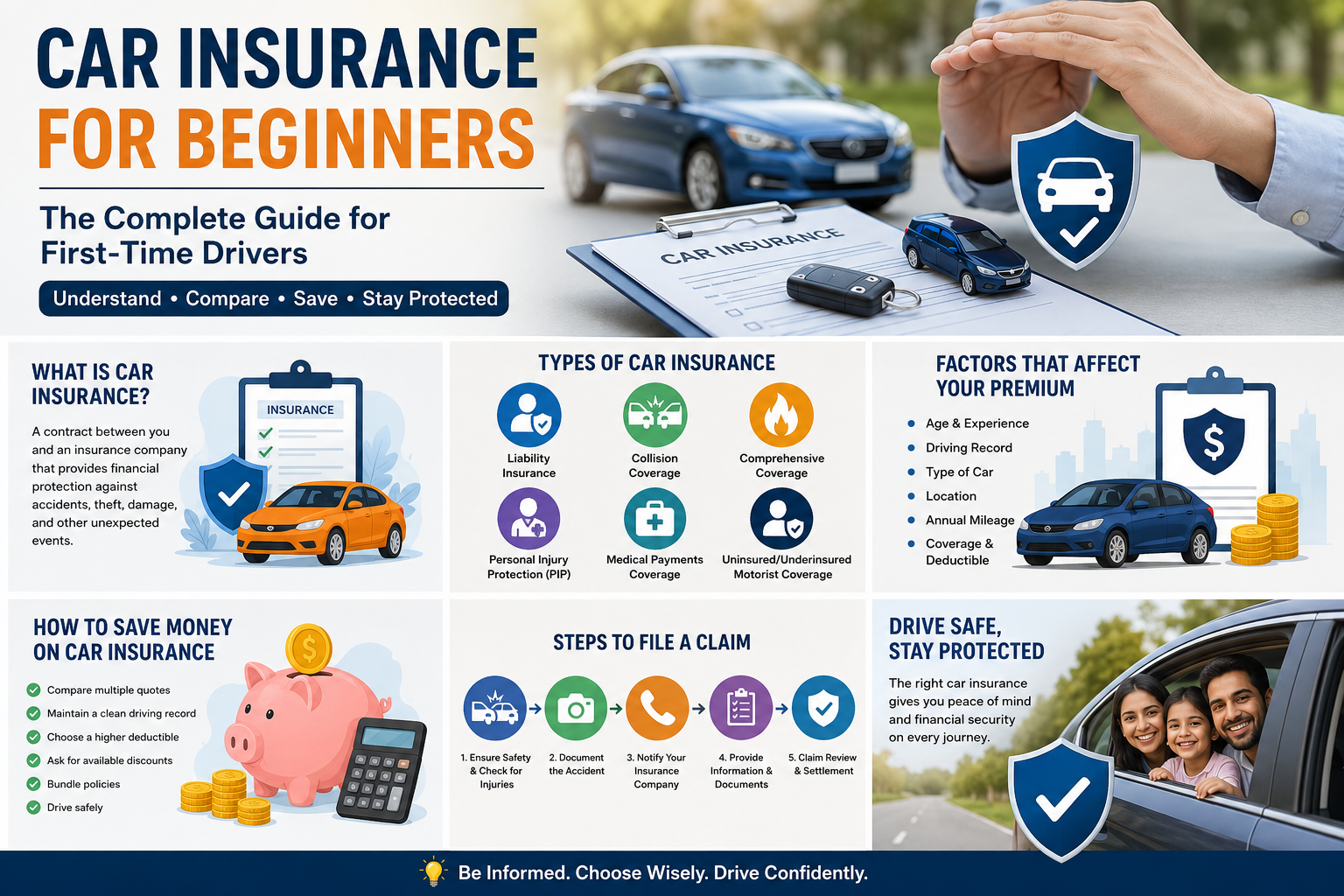
What Is Car Insurance?
Car insurance is a financial agreement between you and an insurance company. In exchange for paying a regular premium, the insurer agrees to cover certain financial losses resulting from accidents or other covered events.
Think of insurance as a safety net.
Without insurance, even a relatively minor accident could cost thousands of dollars or pounds in repairs. A serious collision involving injuries can lead to expenses that many people simply cannot afford to pay out of pocket.
Car insurance helps reduce that financial burden by covering eligible repair costs, medical expenses, third-party damages, and other covered losses according to the terms of your policy.
A Simple Real-Life Example
Imagine you’ve just bought your first car.
One rainy evening, another vehicle suddenly brakes in front of you. Despite your best efforts, you accidentally rear-end it.
Now there are several expenses:
- Repairs to your car
- Repairs to the other driver’s car
- Possible medical bills
- Legal costs if someone files a claim
Without insurance, these costs could easily reach several thousand dollars.
With the right insurance policy, much of that financial responsibility may be covered by your insurer, depending on your policy and deductible.
That’s why insurance isn’t just another monthly bill—it’s financial protection when life takes an unexpected turn.
Why Is Car Insurance Important?
Many first-time drivers wonder if insurance is really necessary, especially if they’re careful drivers.
The reality is that even the safest drivers can’t control everything happening on the road.
Here are the biggest reasons why car insurance matters.
1. It Protects Your Finances
A single accident can wipe out years of savings.
Vehicle repairs have become increasingly expensive due to modern technology, advanced sensors, cameras, electronics, and higher labor costs.
Even replacing a bumper on some newer vehicles can cost well over $1,000.
Insurance protects you from paying these unexpected expenses entirely on your own.
2. It Is Required by Law in Many Places
Most countries require drivers to carry at least a minimum level of car insurance.
Driving without insurance can result in:
- Heavy fines
- Suspension of your driver’s license
- Vehicle impoundment
- Legal action
- Higher insurance costs in the future
Although the exact legal requirements vary between the USA, UK, and India, maintaining valid insurance is generally mandatory before driving on public roads.
3. It Covers Damage You Cause to Others
Accidents don’t just damage vehicles.
They can also result in:
- Injuries
- Property damage
- Legal claims
- Medical expenses
Without liability insurance, you may personally have to pay these costs.
4. It Gives You Peace of Mind
Driving always involves some level of risk.
Knowing you’re financially protected allows you to focus on driving instead of constantly worrying about “what if” scenarios.
Whether it’s a parking lot accident, hailstorm, theft, or unexpected collision, insurance provides valuable peace of mind.
How Does Car Insurance Work?
Understanding how insurance works is much simpler than most beginners think.
Here’s the basic process.
Step 1: You Purchase a Policy
You choose an insurance company and select the coverage that best fits your needs.
Step 2: You Pay a Premium
The premium is the amount you pay for your insurance.
Depending on the insurer, premiums may be paid:
- Monthly
- Quarterly
- Every six months
- Annually
Step 3: An Incident Happens
Suppose your vehicle is:
- Involved in an accident
- Stolen
- Damaged by fire
- Hit during a storm
- Damaged by flooding
- Vandalized
If the incident is covered by your policy, you can file a claim.
Step 4: The Insurance Company Reviews Your Claim
The insurer investigates the incident.
They may ask for:
- Photos
- Police reports
- Repair estimates
- Witness statements
- Vehicle inspection
Step 5: Your Claim Is Settled
Once approved, the insurer pays eligible repair or replacement costs according to your policy terms.
If your policy includes a deductible, you’ll pay that amount before insurance covers the remaining approved costs.
Basic Insurance Terms Every Beginner Should Know
Insurance companies use specific terminology that can initially sound confusing.
Let’s simplify the most important terms.
Premium
Your premium is the amount you pay to keep your insurance active.
Premiums depend on several factors, including:
- Your age
- Driving history
- Vehicle type
- Location
- Coverage level
- Deductible
Deductible
A deductible is the amount you pay before your insurance company contributes toward a covered claim.
For example:
Repair cost: $4,000
Your deductible: $500
Insurance pays: $3,500
You pay: $500
Generally speaking, choosing a higher deductible lowers your monthly premium, but increases your out-of-pocket costs if you need to make a claim.
Coverage
Coverage simply refers to what your insurance policy protects against.
Different policies include different types of protection.
Some cover only third-party damage, while others also cover your own vehicle, theft, natural disasters, and more.
Claim
A claim is your official request to the insurance company asking them to pay for a covered loss.
Claims may involve:
- Vehicle accidents
- Theft
- Fire
- Flood damage
- Storm damage
- Vandalism
- Falling objects
Policy Limit
Every insurance policy has a maximum amount the insurer will pay for covered claims.
If damages exceed that limit, you may have to pay the remaining amount yourself.
Understanding your policy limits is essential when choosing coverage.
Different Types of Car Insurance Coverage
Not all insurance policies provide the same protection.
Understanding each type of coverage helps you buy exactly what you need.
Liability Insurance
Liability insurance is the foundation of most car insurance policies and is legally required in many places.
It covers damage or injuries you cause to other people if you’re responsible for an accident.
Typically, liability insurance includes:
- Bodily injury liability
- Property damage liability
- Legal defense costs (in many policies)
It’s important to remember that liability insurance generally does not pay to repair your own vehicle.
Collision Coverage
Collision coverage pays for damage to your own vehicle after an accident, regardless of who caused it.
Examples include:
- Hitting another vehicle
- Crashing into a pole
- Colliding with a tree
- Rolling your vehicle
If you own a newer or financed vehicle, collision coverage is often recommended.
Comprehensive Coverage
Comprehensive insurance protects your vehicle against events that aren’t related to a collision.
These may include:
- Theft
- Fire
- Flooding
- Storm damage
- Hail
- Falling trees
- Animal collisions
- Vandalism
- Broken windshields
Many first-time buyers mistakenly believe comprehensive insurance covers everything. While it provides broad protection, it still has exclusions outlined in your policy.
Personal Injury Protection (PIP)
Personal Injury Protection helps pay medical expenses for you and your passengers after an accident, regardless of who was at fault.
Depending on your policy, it may also cover:
- Lost wages
- Rehabilitation costs
- Funeral expenses
- Essential services during recovery
PIP availability depends on your country or state.
Medical Payments Coverage
Medical Payments Coverage is similar to PIP but usually offers more limited benefits.
It primarily covers medical expenses resulting from a covered accident.
Uninsured and Underinsured Motorist Coverage
Unfortunately, not every driver carries adequate insurance.
If you’re involved in an accident caused by an uninsured or underinsured driver, this coverage can help pay for:
- Vehicle repairs
- Medical bills
- Lost wages
- Pain and suffering (depending on jurisdiction)
It’s one of the most valuable protections many beginners overlook.
Comprehensive vs. Third-Party Insurance: Which One Should Beginners Choose?
One of the biggest questions first-time car owners ask is whether they should purchase third-party insurance or opt for comprehensive coverage. The answer depends on your budget, the value of your vehicle, and how much financial risk you’re willing to take.
Let’s break it down.
What Is Third-Party Insurance?
Third-party insurance covers damage or injuries you cause to another person, their vehicle, or their property. It is the minimum legal requirement in many countries because it protects other road users from financial loss caused by your actions.
However, there’s an important limitation.
If your own car is damaged in the accident, third-party insurance usually won’t pay for your repairs.
Best suited for:
- Older vehicles with low market value
- Drivers on a tight budget
- Cars that are rarely driven
- Owners who can afford repair costs themselves
What Is Comprehensive Insurance?
Comprehensive insurance offers much broader protection.
In addition to third-party liability, it usually covers damage to your own vehicle from accidents, theft, fire, floods, storms, vandalism, falling objects, and other covered events.
If your car is new, financed, or expensive to repair, comprehensive insurance is generally the smarter option.
Best suited for:
- Brand-new vehicles
- Luxury cars
- Financed or leased vehicles
- Daily commuters
- Drivers living in areas with high theft or extreme weather
Which Option Is Better?
There isn’t a universal answer.
If replacing or repairing your car would create significant financial hardship, comprehensive coverage is often worth the extra premium.
If your vehicle is worth only a few thousand dollars, paying for extensive coverage may not always make financial sense.
Instead of asking, “Which insurance is cheaper?” ask yourself:
“Could I comfortably pay for my car if it were totaled tomorrow?”
That question often makes the decision much easier.
What Does Car Insurance Usually Cover?
Coverage varies between insurance providers, but most comprehensive policies include protection for:
- Vehicle accident damage
- Third-party property damage
- Bodily injury liability
- Theft
- Fire damage
- Flood damage
- Storm damage
- Hail damage
- Glass replacement
- Animal collisions
- Vandalism
- Roadside assistance (optional)
- Rental car reimbursement (optional)
Some insurers also offer optional add-ons, such as engine protection, zero depreciation cover, key replacement, and roadside emergency packages.
Always review your policy carefully so you understand exactly what’s included.
What Isn’t Covered by Car Insurance?
Many beginners assume insurance covers every possible situation. Unfortunately, that’s not the case.
Most policies exclude:
- Intentional damage
- Driving under the influence of alcohol or drugs
- Illegal racing
- Mechanical failures due to wear and tear
- Regular maintenance
- Tire wear
- Engine failure caused by neglect
- Damage caused by using the vehicle for unauthorized commercial purposes
- Driving without a valid license
- War or nuclear events (standard exclusions)
Reading the exclusions section is just as important as reading the list of benefits.
Factors That Affect Your Car Insurance Premium
One of the first surprises new drivers encounter is that insurance prices can vary dramatically—even for similar cars.
Insurance companies use sophisticated risk models to calculate premiums.
Here are the biggest factors.
1. Your Age
Younger drivers generally pay more because they have less driving experience and statistically file more claims.
As you gain experience and maintain a clean driving record, your premiums often decrease.
2. Driving Experience
A driver with ten years of accident-free driving typically receives lower premiums than someone who just earned their license.
Safe driving history is one of the strongest indicators insurers consider.
3. Driving Record
Traffic violations can significantly increase your insurance costs.
These include:
- Speeding tickets
- Reckless driving
- DUI convictions
- Multiple accidents
- License suspensions
A clean driving record is one of the easiest ways to save money over time.
4. Vehicle Type
Some cars cost far more to insure than others.
Insurance companies consider factors such as:
- Repair costs
- Replacement value
- Theft rates
- Safety ratings
- Horsepower
- Availability of spare parts
Luxury vehicles and sports cars usually have higher premiums than family sedans or compact hatchbacks.
5. Location
Where you live plays a major role in determining your insurance premium.
Drivers living in busy cities often pay more because of:
- Higher accident rates
- Increased theft risk
- Traffic congestion
- Greater repair costs
Rural areas generally have lower premiums.
6. Annual Mileage
The more you drive, the more likely you are to be involved in an accident.
Insurance companies often ask how many miles or kilometers you drive each year.
Lower annual mileage may qualify for discounts.
7. Coverage Amount
More coverage naturally costs more.
Adding collision, comprehensive, roadside assistance, rental reimbursement, and other optional protections increases your premium but also provides greater peace of mind.
8. Deductible
Your deductible directly affects your premium.
Choosing a higher deductible usually lowers your monthly payments.
However, remember that you’ll pay more out of pocket if you need to file a claim.
How Much Car Insurance Do Beginners Really Need?
Choosing the right amount of insurance isn’t about buying the most expensive policy.
It’s about finding the right balance between protection and affordability.
Here are some general guidelines.
If You Own a Brand-New Car
Consider:
- Liability coverage
- Collision coverage
- Comprehensive coverage
- Uninsured motorist protection
- Roadside assistance
This combination offers broad protection against most common risks.
If You Own an Older Vehicle
You may decide that liability coverage alone is sufficient if the car’s value is relatively low.
However, if replacing the vehicle would be difficult financially, adding comprehensive coverage may still be worthwhile.
If Your Vehicle Is Financed
Most lenders require borrowers to maintain comprehensive and collision coverage until the loan is fully repaid.
Always check your financing agreement before purchasing insurance.
How to Choose the Best Car Insurance Company
Not all insurance companies are created equal.
Price is important—but it shouldn’t be your only consideration.
Here are some factors to compare before buying.
Customer Reviews
Read reviews from actual policyholders.
Look for comments about:
- Claim settlement
- Customer service
- Transparency
- Speed of payouts
- Complaint handling
Financial Strength
Choose an insurer with a strong financial reputation.
After all, an insurance policy is only valuable if the company can pay claims when needed.
Claim Settlement Process
A good insurance company should make filing claims simple.
Look for insurers that offer:
- Mobile app claims
- Online claim tracking
- 24/7 customer support
- Cashless repair networks
- Quick approvals
Available Discounts
Many companies reward responsible drivers.
Common discounts include:
- Safe driver discounts
- Student discounts
- Multi-car discounts
- Low-mileage discounts
- Anti-theft device discounts
- Defensive driving course discounts
- Bundled home and auto policies
Always ask what discounts are available—you might be surprised.
15 Smart Ways Beginners Can Save Money on Car Insurance
Saving money doesn’t necessarily mean buying the cheapest policy.
It means getting the best value.
1. Compare multiple insurance quotes.
2. Maintain a clean driving record.
3. Choose a higher deductible if financially comfortable.
4. Ask about every available discount.
5. Install anti-theft devices.
6. Park your vehicle in a secure garage.
7. Avoid unnecessary claims for minor damage.
8. Improve your credit score where insurers consider it.
9. Bundle multiple insurance policies.
10. Drive fewer miles each year.
11. Take a defensive driving course if eligible.
12. Choose a vehicle with excellent safety ratings.
13. Review your policy annually.
14. Remove unnecessary add-ons.
15. Shop around before every renewal.
Small savings in several areas can reduce your annual insurance costs significantly.
Common Mistakes First-Time Buyers Make
Buying insurance without understanding the details can lead to expensive mistakes.
Some of the most common include:
- Choosing the cheapest policy without comparing coverage
- Ignoring deductibles
- Underinsuring an expensive vehicle
- Failing to disclose accurate information
- Forgetting to update policy details after moving or changing vehicles
- Not understanding exclusions
- Automatically renewing without comparing competitors
- Assuming every policy offers identical benefits
Taking an extra hour to compare policies today could save you thousands in the future.
Why Reading the Fine Print Matters
Insurance policies often contain valuable details hidden in the terms and conditions.
Before signing, pay attention to:
- Coverage limits
- Waiting periods
- Claim procedures
- Exclusions
- Deductibles
- Optional benefits
- Cancellation rules
- Renewal conditions
Understanding these details now helps prevent unpleasant surprises later.
Step-by-Step Guide: How to File a Car Insurance Claim
Even the most careful drivers can be involved in an accident. Knowing what to do immediately afterward can make the claims process much smoother and improve your chances of a quick settlement.
Step 1: Stay Calm and Ensure Everyone’s Safety
Your first priority should always be safety.
If possible:
- Move your vehicle to a safe location.
- Turn on your hazard lights.
- Check yourself and your passengers for injuries.
- Call emergency services if anyone is hurt.
Avoid arguing with the other driver or admitting fault at the scene. Liability is determined later by the insurance companies and, if necessary, local authorities.
Step 2: Gather Important Information
Collect the following details:
- Name and contact information of the other driver
- Vehicle registration number
- Driver’s license number (where applicable)
- Insurance company name
- Policy number (if available)
- Contact details of witnesses
The more information you gather, the easier it will be to process your claim.
Step 3: Take Photos and Videos
Use your smartphone to document the accident.
Capture:
- Damage to all vehicles
- Road conditions
- Traffic signs
- Skid marks
- Weather conditions
- License plates
- Wide-angle photos of the accident scene
Good documentation can help resolve disputes later.
Step 4: Notify Your Insurance Company
Report the accident as soon as possible.
Many insurers allow you to file claims through:
- Mobile apps
- Online portals
- Customer service hotlines
- Local insurance agents
Provide accurate information and avoid exaggerating or omitting details.
Step 5: Vehicle Inspection
Your insurance company may arrange an inspection of your vehicle before approving repairs.
Some insurers work directly with authorized repair shops, making the process faster and more convenient.
Step 6: Repair and Settlement
Once your claim is approved:
- Repairs may begin.
- Payments are processed according to your policy.
- You’ll pay any applicable deductible.
- The insurer covers the remaining approved amount, subject to policy limits.
Always keep copies of invoices, receipts, and claim documents for future reference.
What Should You Do After a Minor Accident?
Not every accident is serious, but even small incidents should be handled carefully.
Here’s a simple checklist:
- Stay calm.
- Ensure everyone is safe.
- Exchange contact and insurance details.
- Take clear photographs.
- Avoid admitting fault.
- Inform your insurer promptly.
- Keep records of all communication.
Reporting even minor accidents can protect you if additional damage or injury is discovered later.
Is the Cheapest Car Insurance Always the Best?
Many beginners focus solely on finding the lowest premium. While saving money is important, choosing the cheapest policy without comparing coverage can be an expensive mistake.
A low-cost policy may have:
- Higher deductibles
- Lower coverage limits
- More exclusions
- Slower claim processing
- Fewer customer support options
Instead of asking, “Which policy is the cheapest?” ask:
- Does it provide enough coverage?
- Is the insurer reliable?
- Are claims handled efficiently?
- Does it fit my budget and needs?
The best car insurance offers the right balance between affordability and protection.
Car Insurance Tips for First-Time Drivers
If you’re buying your first policy, these practical tips can help you make smarter decisions.
Compare Quotes
Never settle for the first quote you receive. Comparing several insurers can reveal significant differences in pricing and benefits.
Understand What You’re Buying
Take time to read the policy documents. Understanding your coverage now can prevent costly surprises later.
Review Your Policy Every Year
Your insurance needs change over time. Review your coverage annually to ensure it still matches your circumstances.
Drive Safely
Safe driving not only protects you and others but can also lead to lower premiums through no-claim bonuses or safe driver discounts.
Ask Questions
Insurance agents and customer support teams are there to help. If you don’t understand a term or condition, ask before purchasing.
Frequently Asked Questions (FAQs)
1. What is car insurance?
Car insurance is a contract between you and an insurance company that provides financial protection against covered losses, such as accidents, theft, fire, or damage caused to others.
2. Is car insurance mandatory?
In most countries, including the USA, UK, and India, at least a minimum level of car insurance is legally required to drive on public roads.
3. What is the difference between liability and comprehensive insurance?
Liability insurance covers damage you cause to others, while comprehensive insurance also protects your own vehicle against accidents, theft, fire, natural disasters, and other covered events.
4. What is a deductible?
A deductible is the amount you pay out of pocket before your insurance company contributes to a covered claim.
5. Can I change my insurance company?
Yes. Many drivers switch insurers when they find better coverage, lower premiums, or improved customer service. Be sure to avoid any gap in coverage.
6. Will my premium increase after an accident?
It may. Premium increases depend on factors such as fault, claim history, the severity of the accident, and your insurer’s pricing policies.
7. Does car insurance cover theft?
If you have comprehensive coverage, theft is generally covered, subject to the terms and conditions of your policy.
8. Does insurance cover flood damage?
Flood damage is usually covered under comprehensive insurance, but it is not typically included in liability-only policies.
9. How can I lower my insurance premium?
You may reduce your premium by maintaining a clean driving record, comparing quotes, increasing your deductible, bundling policies, and taking advantage of available discounts.
10. Is comprehensive insurance worth it?
For newer, financed, or high-value vehicles, comprehensive insurance often provides valuable financial protection against a wide range of risks.
11. How often should I review my policy?
Review your policy at least once a year or whenever there is a major life change, such as moving, buying a new car, or adding another driver.
12. Can I insure a used car?
Yes. Used cars can be insured with either liability-only or comprehensive coverage, depending on their value and your financial situation.
13. What happens if I drive without insurance?
Driving without required insurance can result in fines, license suspension, vehicle impoundment, and legal penalties, depending on your local laws.
14. Does my credit score affect my insurance premium?
In some regions, insurers use credit-based insurance scores when determining premiums. This practice varies by country and state.
15. Can I cancel my policy at any time?
Most insurers allow policy cancellations, although cancellation fees or refund rules may apply. Always review your policy terms before cancelling.
Final Thoughts
Buying car insurance for the first time may seem overwhelming, but it doesn’t have to be. Once you understand the basic concepts—such as premiums, deductibles, coverage types, and claims—you’ll be in a much stronger position to choose a policy that suits your needs and budget.
Remember that the cheapest policy isn’t always the best choice. Focus on value rather than price alone. Compare coverage options, read the fine print, check customer reviews, and make sure the insurer has a strong reputation for handling claims efficiently.
As your driving experience grows, your insurance needs will evolve. Review your policy regularly, maintain safe driving habits, and compare quotes before each renewal. These simple steps can help you save money while ensuring you remain well protected.
Whether you’re driving through the busy streets of New York, navigating the motorways of London, or commuting in Mumbai, the right car insurance policy offers more than legal compliance—it provides financial security and confidence every time you get behind the wheel.
A well-chosen policy protects not only your vehicle but also your savings, your future, and your peace of mind. Take the time to understand your options today, and you’ll be better prepared for whatever the road brings tomorrow.
Key Takeaways
- Car insurance protects you from unexpected financial losses.
- Understand the difference between liability, collision, and comprehensive coverage.
- Compare multiple insurers before buying a policy.
- Read the policy wording carefully, including exclusions and deductibles.
- Safe driving and annual policy reviews can help reduce your insurance costs.
- Choose coverage based on your vehicle’s value, driving habits, and financial situation—not just the lowest premium.